Marker coming into his own
Jan. 4th, 2026 06:17 pm![[personal profile]](https://www.dreamwidth.org/img/silk/identity/user.png) jreynoldsward
jreynoldsward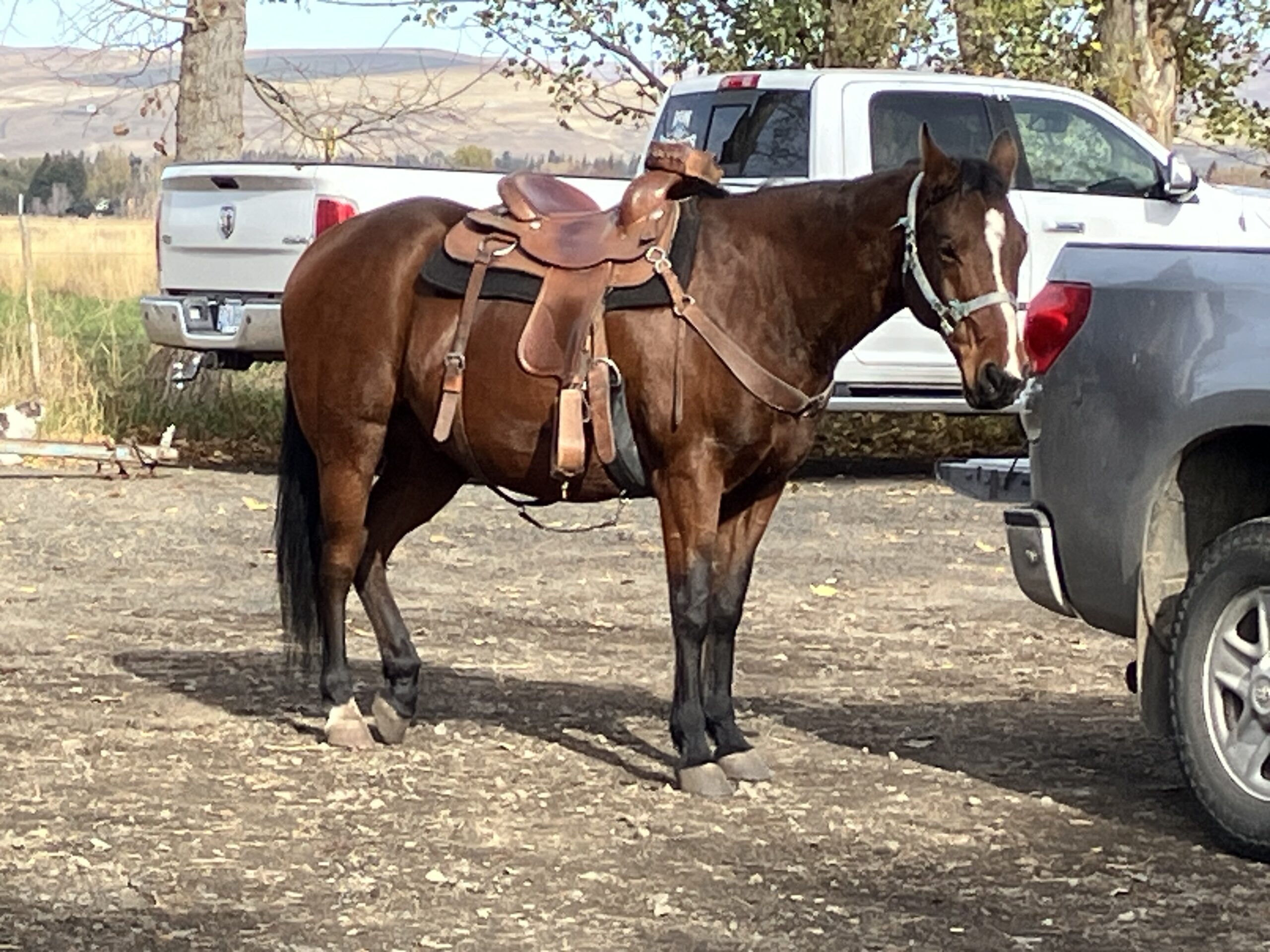
2025--most precisely, the fall of 2025--is when Marker really started coming together under saddle. In part this was due to me doing a lot of arena work on him, including basic schooling, focusing on getting his canter leads right but also doing a lot of lateral work such as two-tracking, shoulder-in, haunches-in, and so on. We also did a lot of pattern work and started doing the really fussy stuff involving sidepassing and backing through ground pole patterns. The fussy work didn't come along as well--that's a goal for 2026--but canter leads and lateral work showed progress.
Along with saddle work came a distinct improvement in ground manners. While old Mocha definitely played a role in ground manners--the old girl had very strong opinions about manners and was not afraid to tell Marker about an infringement of the Mocha Rules--after her death it somewhat seemed like he realized that he was the Only Horse and that he needed to step up to the plate, behaviorally. Of course, part of it is that he is very much a human-oriented horse and isn't very interested in sharing His People. He's become quite polite about his grain. Lately, when I bring him in from the field, if no one else is doing anything in the barnyard, I can toss the rope over his withers and tell him to "go to the rail." He stops at the edge of the mats (despite seeing the grain bucket right there--such a temptation!) to wait for a cookie, then turns his head away until I say "All yours now" and step back from the bucket.
That turning away of his head is definitely one of his coping mechanisms when there is something that is just so tempting but he can't touch it. Or play with it. He's done it when I've gotten after him for playing with the grooming caddy.
But it's also clear that he is a horse with Big Emotions, and while he's made significant strides in emotional self-regulation, he still has things to work out when it comes to his emotional expressions, especially in a herd setting. However, he's a horse who understands a lot of human words, or at least human vocal tones. "Good boy" has a small positive response from him, and "bad boy!" elicits a droopy, sorrowful expression. I haven't had to use it much lately. We'll see what happens in springtime, though.
These days, he's 95% at giving me the correct canter lead when I ask for it, and I can usually figure out reasons for why he doesn't always get that correct lead (usually due to soreness or I didn't set him up right). There's very little of the switching leads when he gets tired. Part of that is due to conditioning. Some horses need a lot of conditioning time to get a nice smooth canter, or to hold a particular lead. Gaited horses like Marker also have some different wiring as to whether they can pick up a proper canter from whatever their intermediate gait is, whether that's singlefoot, running walk, or fox trot like Marker does. Time and conditioning work wonders in that situation--something I learned from Mocha, who took a year from purchase time to getting a canter in the arena that didn't scare the other riders (or me! She went all over the place with a rider). But in Mocha's case, she'd been on a long layoff due to a tongue injury, and once we went through the initial conditioning phase her canter was always pretty good--I learned the value of taking time for conditioning from her.
Marker now has a nice, relaxed, rocking horse canter on his left lead. It's very smooth, slow, and on a slack rein--basically, the weight of a latigo leather rein on a loose ring snaffle. We're getting there on the right lead--he strained his left hind this fall, which is the driver of a good right lead canter. Right lead has somewhat been a challenge at times because that's the one where he's most likely to swap leads when he starts feeling tired or sore. So...since we're in the field for the winter, it's lots of straight line canter work for a distance. And it's coming along--I can now sit that canter instead of needing to go into a half-seat so he can move freely underneath me. It's no longer as rushed as it was. We have moments where it feels like the left lead, and those are happening more often.
I spend winters riding and schooling in the field. It's a throwback to my youth, where I had no access or means of transport to an indoor arena, so I rode a lot in a swampy field. One advantage of field riding is that if the field is big enough, you can do that straight line work to build strength. And Marker, unlike Mocha, has no problems negotiating diagonals across the field due to footing. We do a lot of fox trot work to improve his ability to gait on rough footing. Boy also likes his fox trot--he will happily zone out while fox trotting along, moving nice and relaxed in light collection.
Winter goals right now are to make that right lead as smooth and relaxed as the left lead. Which just takes time and practice. Then there's the fox trot on rough footing. More than that has to wait until we can get into the arena--more pattern work, and work over ground poles that includes learning to relax when sidepassing and turning over a pole corner. I also have to figure out his sweet spot--his turning radius differs from Mocha's, because she could turn a lot faster and smoother on her haunches than he can. Other things he needs to work on include being able to work calmly around a lot of other horses. That has to wait until summer and local horse events. I'm doing some of it now by riding him in and around the herd. And being calm when there's a lot of chaos going on around him. He's pretty good at it around the barn, but he needs to develop that skill elsewhere. It's just a matter of time and exposure.
Another winter goal is working on reducing the strength of my cues. Which--he's pretty responsive to turning from a weighted seat bone, even if he isn't rounding up as much as I would like when working in serpentines. That's a mutual goal because I have to maintain the strength to cue softly. He also is responsive to me turning my head along with a weighted outside seatbone. Could I take him bridleless? Possibly--more likely than I ever could do with Mocha. But we have some work to get there. In the meantime, we're working on softer, softer cueing. Which, again, falls back on me as well.
One biggie for me is working on getting my legs back and not leaning forward as much as I can do when going into canter. I'm also planning to spend time working on bareback riding--I'd like to be able to canter Marker in the arena while riding bareback. That's important for my core strength and balance. I'd like to find a reasonably priced dressage saddle that can fit the boy's round barrel because that will help me as well. But until then, working bareback will be a big help on the core strength and balance front (I also do weight work off of the horse, too).
Overall, he's definitely not a show horse type, at least from what he's shown me so far. But taking him to local shows also helps him acquire that emotional self-regulation he needs to develop in strange settings (the standout from his first show last summer involved him screaming in my ear--literally, nose right there--as well as deciding partway through the under saddle class that he was done and pitching a temper tantrum because he wanted to go out of the gate on the other side of the arena and GET AWAY FROM ALL THIS STUFF NOW). He's also a pretty darn nice and steady road riding mount, with a few exceptions (YAKS!!! Bicycles! EBIKES!!!). Which--I also want to work on.
All in all, he's coming along nicely and is a good safe mount for a skilled senior rider. When I look back at my Mocha training notes, I notice that not only is he coming along faster, it's with much fewer problems. Old mare had her opinions. Sometimes they didn't match mine as a trainer--and she had no qualms about bucking in her young years. He's less likely to argue with me, and wants to please. Some of this is the difference between a mare and a gelding--but another is the difference in temperaments. I've ridden geldings with strong opinions, too.
So yeah. The boy and I are going nicely into 2026. We'll see what it brings.


